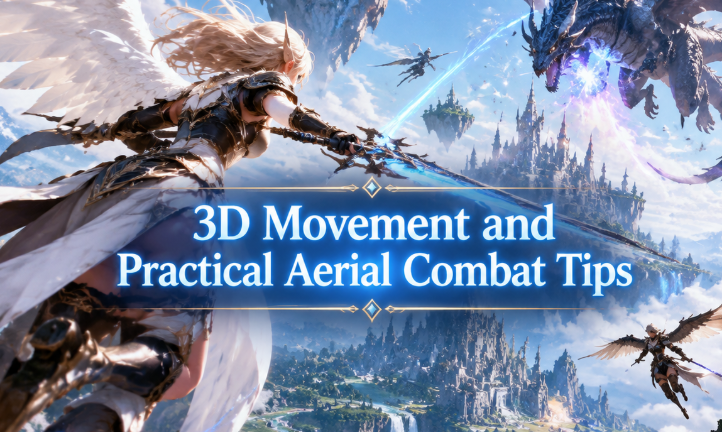
Aion 2 Flight Combat: 3D Movement and Practical Aerial Combat Tips
Flight is one of the most distinctive features of Aion 2. Instead of being limited to traditional ground combat, players can move through the air, change altitude, approach enemies from different directions, and combine aerial movement with ground-based attacks. This adds another layer of positioning that players need to understand from the beginning.
For new players, aerial combat can feel very different from a normal MMORPG. The battlefield is no longer flat, and enemies can attack from multiple angles. Learning how to control your character in three dimensions will make both exploration and combat much easier.
Understanding Aerial Movement
The first step is learning how flight and gliding work together.
Flight allows you to move freely through the air, while gliding gives you more controlled movement when descending or traveling. Both are useful, but they serve different purposes during combat.
Your flight resource should always be treated as something valuable. Flying continuously without paying attention to it can leave you in a bad position when you actually need to escape or dodge.
A good habit is to check your flight resource before starting a long aerial chase.
Why Three-Dimensional Movement Matters
Ground combat mainly requires players to think about distance and direction. Aerial combat adds height to the equation.
An enemy can be:
- Directly in front of you
- Above or below you
- Moving diagonally
- Approaching from behind
- Changing altitude during combat
This means simply moving sideways is not always enough.
Changing altitude can create space, avoid incoming attacks, or give you a better angle for your next attack. Instead of constantly flying forward, try combining horizontal movement with short vertical adjustments.
The goal is not to fly as much as possible. The goal is to control your position.
Combining Air and Ground Combat
Aerial combat should not be treated as a completely separate system from normal combat. Good players will move between the ground and air depending on the situation.
For example, you can begin an encounter on the ground, observe an enemy’s attack pattern, then take flight when vertical movement becomes useful. After avoiding the dangerous attack, you can reposition and return to the ground for another skill sequence.
This approach also helps you conserve resources.
A simple combat flow is:
- Start by identifying the enemy’s position and attack pattern.
- Take flight when vertical movement provides an advantage.
- Change altitude instead of moving in predictable straight lines.
- Use attacks while maintaining a safe position.
- Return to the ground when your flight resource becomes low.
- Repeat the transition when another aerial opportunity appears.
- Practical Flight Combat Tips
- Keep Your Target in View
Camera control becomes extremely important during aerial fights. Losing sight of your target can quickly turn a manageable encounter into a difficult one.
Practice moving upward and downward while keeping the enemy centered on your screen.
Do Not Fly in Straight Lines
A predictable flight path makes your movement easier to read.
Use small directional changes and altitude adjustments. You do not need to make huge movements every second. Short, controlled changes are usually easier to manage.
Save Flight Resources
Do not spend the entire flight gauge simply because the option is available.
Before chasing an enemy, consider whether you still have enough resources to:
Dodge an incoming attack
Change altitude
Continue the chase
Retreat if necessary
Resource management becomes especially important during longer encounters.
Use Altitude Defensively
Flying is not only an offensive tool.
Sometimes gaining altitude and creating distance is the safest decision. You can wait for an enemy attack to finish, then move back into position when the opening appears.
This is especially useful when learning a new enemy or boss.
Common Beginner Mistakes
New players often make three mistakes when learning aerial combat.
First, they stay airborne for too long. Second, they move in predictable straight lines. Third, they focus so much on attacking that they lose track of their flight resources.
Another common mistake is assuming every fight should be taken into the air. Some situations are easier to control from the ground.
The best players will switch between both combat spaces instead of relying exclusively on one.
Managing Your Early Progression
Learning flight mechanics should come before worrying about rushing your character’s progression. Your early Aion 2 Kinah is better spent on useful equipment, consumables, and other necessities than on unnecessary purchases.
As you become more familiar with the combat system, you will naturally become faster at clearing content and managing your resources.
Aerial combat gives Aion 2 a different rhythm from traditional ground-based MMORPG combat. The most important skill is not simply learning how to fly, but learning when to fly, where to move, and when to return to the ground.
Think of altitude as another part of your positioning toolkit. A small vertical adjustment can sometimes be more valuable than a long horizontal movement.
Once you understand camera control, flight-resource management, three-dimensional positioning, and ground-to-air transitions, aerial combat becomes much easier to control.
Players looking to speed up progression may also encounter discussions about Aion 2 Boosting, but mastering movement and combat mechanics yourself is still important. Understanding how your class performs in both ground and aerial situations will give you a much stronger foundation for everything that comes later.
