Path of Exile 2 Tablets: How to Obtain Them and Get 20 Uses
Tablets in Path of Exile 2 help tailor endgame maps to the encounters and rewards you want to farm. Their type determines the content they add or modify, while their affixes influence how rewarding that content becomes. Remaining uses matter just as much: a strong Tablet with several charges left offers a different investment from an almost exhausted one. Under the 0.5-era system, Tablets are placed in the Map Device rather than applied to Precursor Towers.
How to Obtain Tablets
Farm Endgame Maps
Mapping is the main route for collecting encounter-specific Tablets. In patch 0.5.0, league-specific Tablets were restricted to map areas, so separate destinations such as the Simulacrum, Abyssal Depths, and Twisted Domain no longer provide those Tablet drops. Running a mechanic’s dedicated endgame area is therefore not a substitute for farming its Tablets in maps.
For a practical farming routine, choose maps your character clears consistently before increasing investment. Fully modified T15 maps provide a starting point for established builds, with corrupted maps serving as a higher-investment option. Irradiated Tablets with Waystone-drop modifiers are also used in Tablet-farming setups, but no setup guarantees a particular number of drops or a fixed currency return.
Avoid judging a farming strategy from one unusually rewarding map. Track the cost of your Waystones, Tablets, and preparation currency across a batch, then compare that spending against the items you actually sell. Unsold Tablets should not be counted as realised profit.
Trade for Bases or Finished Tablets
Buying Tablets from other players lets you target a particular mechanic without waiting for suitable drops. Cheap bases suit crafting projects, while finished Tablets save the currency and uncertainty involved in rolling modifiers. Full-use bases are especially relevant when preparing a corruption attempt aimed at reaching 20 uses.
Compare remaining charges alongside the asking price. Dividing the price by the remaining uses gives a useful starting point, although affix quality still matters. A cheaper Tablet is poor value if its modifiers do little for your farming strategy.
What Makes a Tablet Worth Keeping?
Look for modifiers that support the encounter you intend to run. Breach Tablets benefit from additional rare monsters when unstable Breaches stabilise, while Ritual Tablets gain appeal from additional favour rerolls. Abyss-focused setups can favour additional encounters and rare monsters, and Delirium farming often prioritises splinter-related bonuses. Supporting modifiers such as effectiveness and rarity are most attractive when paired with a useful mechanic-specific affix.
A useful distinction is between a good Tablet for personal use and a premium crafting project. You do not need perfect modifiers to begin mapping. Once an item supports your chosen strategy, further rerolling should have a clear purpose and a spending limit.
How to Craft Tablets
Before spending currency, check the relevant Atlas unlocks. Tablets do not automatically follow the same rare-item crafting progression as ordinary equipment. Atlas passives enable upgrading them to rare rarity and increase their modifier allowance, allowing up to four explicit modifiers before corruption with the appropriate unlocks.
A practical preparation method is to identify your Tablets and separate promising bases from weak ones. Preserve useful magic modifiers when upgrading with a Regal Orb. Use an Orb of Alchemy on a suitable normal base, then evaluate whether further changes are worth the expense. POE 2 Exalted Orbs can fill available modifier slots, while Divine Orbs refine numerical values on an already desirable result. The demonstrated Abyss crafting process follows this pattern, including refining an additional-rare-monster modifier before corruption.
Keep ordinary mapping Tablets separate from expensive corruption candidates. This prevents a productive farming supply from turning into an unrestricted crafting session.
How to Get a Tablet With 20 Uses
A 20-use Tablet is obtained through a favourable Ancient Infuser corruption. Ancient Infuser is the correct item name, rather than “Ancient Diffuser.” It unpredictably modifies and corrupts a Tablet, with possible outcomes including additional uses, an extra modifier beyond the usual limit, transformation into another Tablet type, or destruction. A successful outcome can add up to ten uses, allowing a 10-use base to reach 20.
Prepare the Tablet before taking that risk. Select a full-use base, finish the modifiers you want, and decide whether the potential upgrade justifies losing the original item. Corruption is not a dependable finishing service; it is a gamble on an item that already has value.
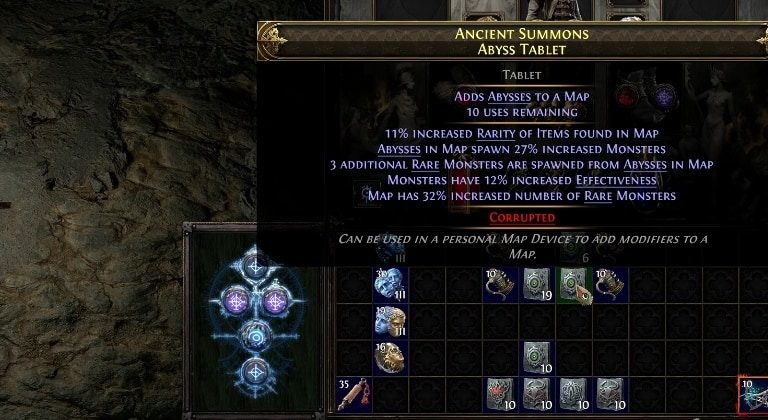
The demonstrated eight-Tablet batch shows that uncertainty clearly. Its best charge result reached 19 uses rather than 20. Several Tablets changed type, two gained a fifth modifier, and another ended with six uses instead of ten. Those results illustrate the range of outcomes, but eight attempts do not establish reliable odds for hitting the maximum.
How to Obtain Ancient Infusers
Ancient Infusers are associated with Atziri’s Temple. They can be taken as an itemised reward from the Tablet Research Vault instead of using its crafting bench, and they can also drop from the Royal Trove after defeating Atziri. Obtaining the currency is separate from obtaining the desired corruption result.
Budget for both the Infuser and the Tablet you are risking. If your goal is simply to run more maps with strong modifiers, compare the cost of a finished high-use Tablet against the total cost of repeated attempts. Stop crafting when the next gamble costs more than the improvement is worth to your farming plan.

