Exploring Elden Ring’s Cosmic Creatures: What Astel and the Fallingstar Beast Tell Us About the World’s Hidden Design
Elden Ring has no shortage of bizarre, haunting, and downright fascinating enemies, but few are as memorable as the beings that seem to come from beyond the Lands Between. If you’ve spent enough time diving into caves, crater pits, or the darker corners of the underground, you’ve definitely met them. And if you’re anything like me, you’ve probably wondered how these cosmic horrors fit together in the game’s enormous lore puzzle.
After revisiting the transcript and replaying a few of these encounters myself, I’m more convinced than ever that FromSoftware intentionally designed a complete life cycle around Astel, the Fallingstar Beasts, and the mysterious withered variants lurking in remote nooks of the world. And honestly, once the pieces click, it becomes one of the coolest bits of world-building the game quietly hides from players.
Let’s break down what’s really going on, and what all this means for anyone exploring, theorizing, or gearing up for their next NG+ run.
Similarities You Can Spot Without Even Trying
The connection between Astel and the Fallingstar Beasts becomes obvious once you’ve fought both enough times. Their mandibles, their tails, their gravity-based attacks—these aren’t coincidences. The visual design practically begs you to notice that these creatures share more than a cosmic origin story.
But what really caught my attention during my own playthroughs is that subtle moment when you start recognizing Astel’s facial structure hiding beneath the mature Fallingstar Beast’s fur. Datamined models confirm it: the “hidden” face is basically Astel’s, just waiting to develop further.
If you’re doing a build that requires high-level items or materials, this is also where you’ll end up grinding frequently. One of the most convenient tricks for speeding the process along is to buy elden ring runes when you just want to jump straight to boss practice or item hunting instead of spending hours farming. It’s something a lot of experienced players rely on when they’re optimizing new builds or testing unusual setups.
Digging Deeper into the Lore
Even though the game doesn’t explicitly state their connection, the clues are scattered everywhere.
Astel’s remembrance calls it a malformed star born in a lightless void. The Fallingstar Beasts are described in sorcery lore as coming from “the lightless dark far beyond.” Two entities from the same kind of origin, who wield the same gravitational powers, who share the same insectoid-celestial anatomy—it’s hard not to see them as parts of a shared species line.
The Japanese text deepens the link. Astel’s title translates more closely to “bastard of the void,” while the Fallingstar beasts use a term that means “falling star.” Related ideas, different nuances. But the underlying message is the same: these creatures are alien, and they’re part of a larger cosmic ecosystem invisible to most of the Lands Between.
Real-World Inspirations Make the Theory Even Stronger
One of my favorite discoveries from the transcript was the comparison to antlions. If you’ve ever seen one, the resemblance is uncanny—both in appearance and behavior. Antlions start as burrowing predators with wide mandibles before transforming into delicate winged lacewings later in life.
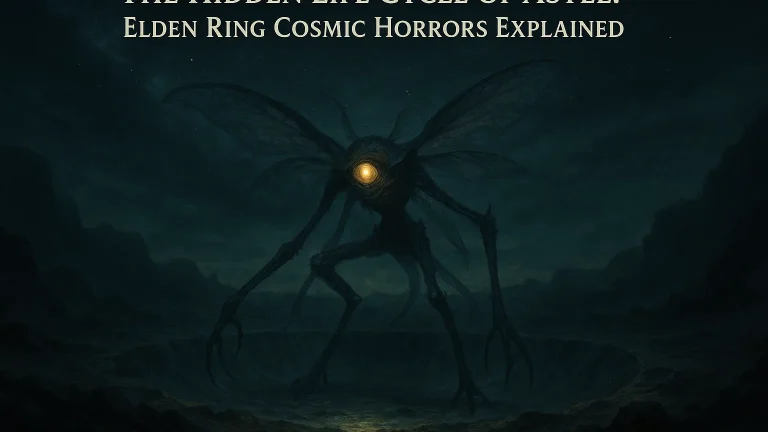
Now look at the Fallingstar Beast. It’s the burrower, hiding in massive craters. Then look at Astel—thin limbs, long body, translucent wings, far more elegant and developed. Suddenly the comparison feels less like a coincidence and more like a blueprint.
To make a long story short: the Fallingstar Beast looks like the larval phase. Astel looks like the adult.
And that brings us to the final stage.
What About Those “Withered” Astel Variants?
If you’ve wandered into Perfumer’s Grotto or the Ainsel Depths, you’ve undoubtedly seen those eerie dried-up Astel-like creatures tucked away in the shadows. They’re weaker, slower, brittle. Their wings are faded. Their bodies have lost color. They barely resemble the glowing titan you fought as a boss.
Guidebook translations call them “Withered Astel,” and the name couldn’t be more fitting. They look and fight like cosmic beings that have reached the end of their lifespan—empty spheres, withdrawn limbs, almost like they’re collapsing inward.
Seeing them after understanding the earlier stages gives the whole thing a melancholy vibe. These aren’t mini-bosses or variants—they’re the elder ghosts of a species we only meet at its extremes.
What This Means for Players
FromSoftware rarely spells things out, but they love threading subtle meaning through enemy design. Understanding how Astel and the Fallingstar Beasts connect changes the entire feel of exploring their habitats. Those craters aren’t just random impact sites—they’re nests. Those caves aren’t just creepy set pieces—they’re dark cocoons.
It also helps explain why these enemies hold such valuable materials. They’re literally creatures evolving from alien minerals and cosmic energy. No wonder half their drops end up in late-game upgrades.
And if you ever find yourself stuck farming these enemies for upgrade stones or experimentation builds, remember that some players rely on buy elden ring runes u4gm instant delivery services for convenience. When you’re juggling school, work, or just want to get straight to DLC bosses, it’s an easy way to skip repetitive grinding. Platforms like U4GM offer those options, and a lot of high-level players use them to gear up quickly for challenge runs or speed-test new builds.
Exploring the Lands Between with New Eyes
Once you recognize the shared anatomy, the “life cycle” idea is hard to unsee. The Fallingstar Beast craters feel like hatcheries. Astel’s boss arenas feel like cocoons of gravity-warped evolution. The withered forms feel like a final resting stage, tucked away where players rarely bother to look.
This type of detail is why Elden Ring remains so endlessly rewarding. Even years after release, players are still uncovering new layers of meaning—often hidden right in front of us. And that’s exactly the magic of FromSoftware’s design philosophy.
Summary
Astel, the Fallingstar Beasts, and the Withered Astel seem to represent a full cosmic life cycle that blends alien mystery with real-world insect inspiration. Visual design, lore descriptions, underground placement, and even soundtrack choices all point toward a deliberate evolutionary relationship. Understanding this connection adds depth to the world and gives players new context for some of Elden Ring’s most memorable encounters.
Trending Now: Elden Ring Nightreign Release Date: May 30, 2025